







Search Results for: operating profit
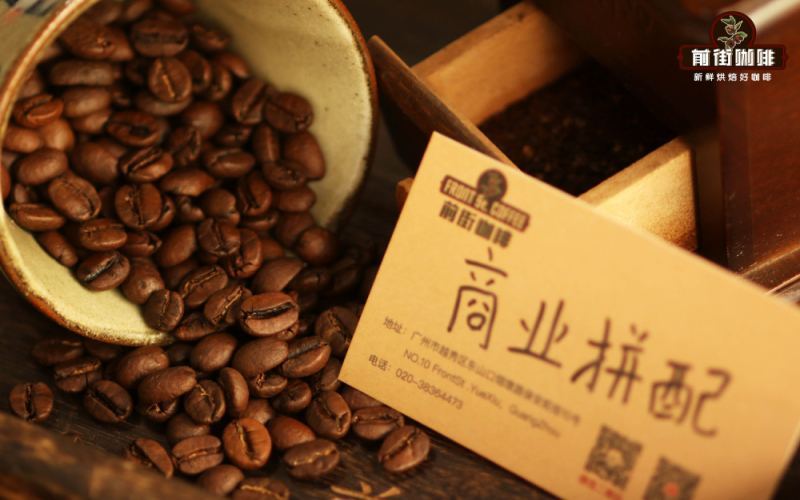
Must-Read Before Opening a Coffee Shop: The Raw Material Costs, Operating Expenses, and Final Profit Margin of a Cup of Coffee
Many friends who want to open a coffee shop ask: how much does a cup of coffee actually cost, and how much can you make? In reality, the raw material cost of coffee isn't high. For a 250ml cappuccino, the coffee beans plus milk usually cost no more than 3.5 yuan. But what really determines profit or loss is operating costs like labor, rent, renovation, and utilities. Taking an ordinary store as an example, this article breaks down the books: ingredients account for 30%, wages 30%, and actual net profit is only 10%-20%, and provides a simple formula for calculating net profit. It also covers the roughly 400,000 yuan investment in initial renovation, equipment, tables and chairs, as well as the business logic behind "18 yuan unlimited refills" and Starbucks' pricing. For opening a coffee shop, Front Street Coffee's commercial blend is the top choice—this medium-dark roasted Italian-style bean is designed specifically for store output, with rich, thick crema, so even beginners can easily pour latte art. [more…]
Luckin adds ten thousand stores in a year, overtaking Mixue Ice Cream & Tea; behind the scale expansion lies mounting profit pressure and the dilemma of a price war.
Luckin Coffee has broken records in the chain coffee industry at an astonishing speed, adding 10,000 net new stores within a year, bringing its total store count close to 20,000, with an expansion pace even surpassing Mixue Bingcheng. However, alongside this runaway scale, problems have followed one after another: a swing from profit to loss in the first quarter, a decline in net profit margin in the second quarter, and a year-on-year drop in same-store sales at directly operated stores. The 9.9 yuan promotional campaign has lowered the average transaction value, making it a real challenge to increase revenue without increasing profit. Facing a price war with rivals such as Cotti and Starbucks, how Luckin balances scale and profitability will be a key proposition for its future operations. [more…]
Luckin Coffee emerges from financial scandal to achieve first profit, with over 6,500 stores nationwide
Luckin Coffee, once mired in a crisis due to financial fraud, has now delivered a remarkable report card. According to the latest first-quarter earnings report for fiscal year 2022, Luckin not only saw a significant increase in net revenue but also achieved overall profitability for the first time. At the same time, its total number of stores has grown to 6,580, surpassing Starbucks to become one of the largest coffee chain brands in the Chinese market. From the hit product Coconut Latte to Coconut Cloud Latte, Luckin's R&D capabilities have become a key driving force behind its turnaround. This article will take you through Luckin's road to a comeback and analyze the growth logic behind it. [more…]
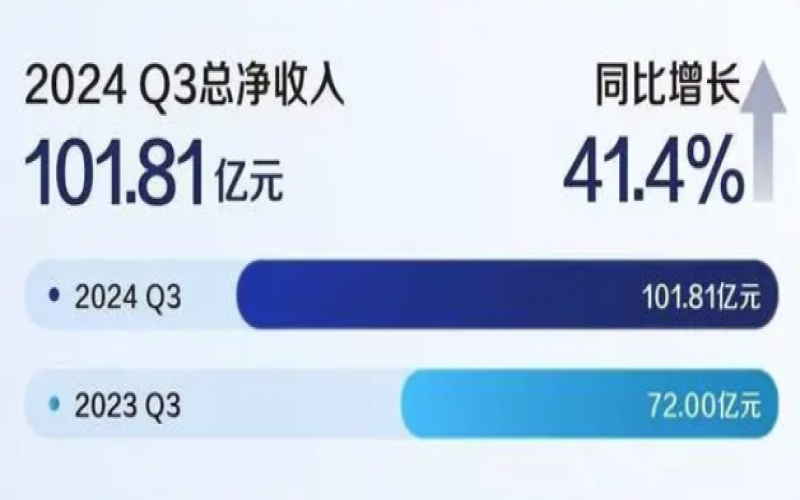
Luckin Coffee's Q3 revenue tops 10 billion for the first time: stores exceed 20,000, product innovation drives growth
On October 30, 2024, Luckin Coffee released its third-quarter financial report, with total net revenue for the quarter reaching 10.181 billion yuan, a year-on-year increase of 41.4%, marking the first historic breakthrough of quarterly revenue exceeding 10 billion yuan. Alongside revenue growth, operating profit and net profit also performed steadily. The store scale continued to expand to 21,343, firmly holding the top position in China's coffee industry, with both self-operated and partnered store revenues achieving double-digit growth. Behind this support is a mature supply chain system and continuous product innovation. This article will analyze the causes of Luckin Coffee's quarterly 10 billion yuan achievement from aspects such as financial report data, store expansion, operational models, and product strategies, and also focus on its future growth potential. [more…]
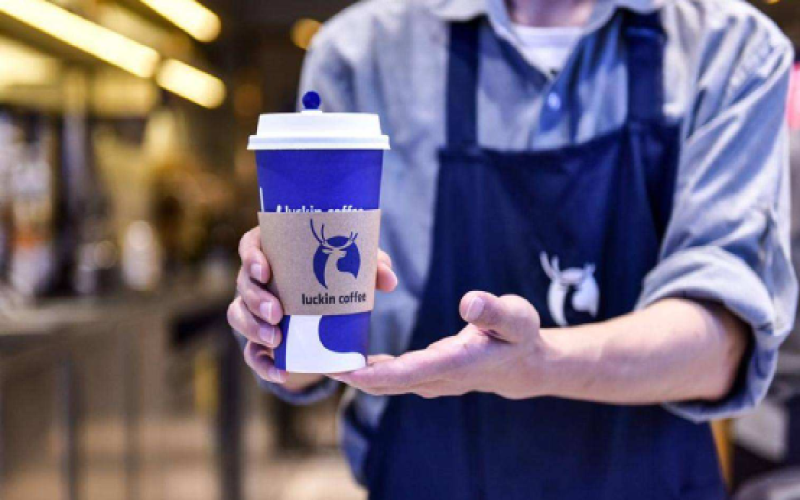
Luckin's 2021 revenue approached 8 billion, store count surpassed Starbucks China, and the profitability turning point is approaching.
Luckin Coffee's total net revenue for the 2021 fiscal year reached 7.965 billion yuan, a year-on-year surge of 97.5%, with fourth-quarter revenue of 2.4327 billion yuan, an increase of 80.7%. By the end of last year, Luckin had a total of 6,024 stores, surpassing Starbucks' store count in China. Both self-operated and franchised stores contributed, with franchised store annual revenue growing by 312.5%, and lower-tier markets making a significant contribution. Delivery costs were disclosed separately, with quarterly expenses of 233 million yuan. Non-GAAP operating loss narrowed to 23.6 million yuan, with profitability close at hand. After completing the interim liquidation, Luckin expects costs related to fraudulent transactions to significantly decrease in the second quarter of 2022. There is continued external interest in its return to the Nasdaq main board. [more…]
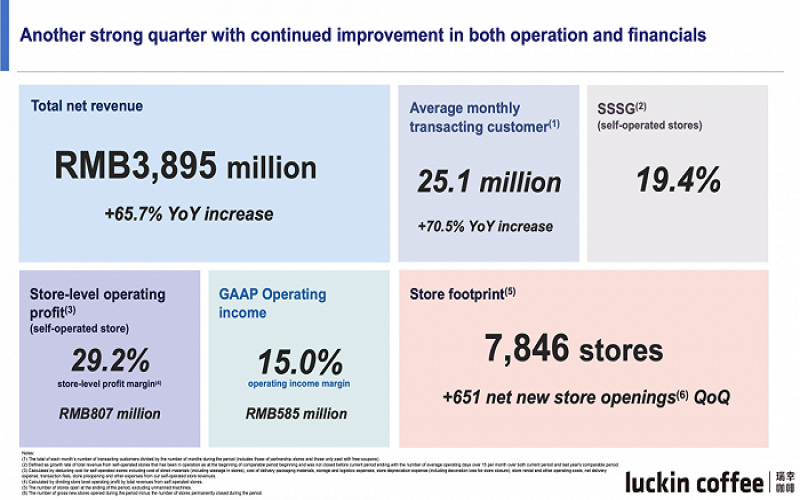
Luckin's Q3 net profit exceeds 500 million, achieving a turnaround, and it will restart franchise recruitment in lower-tier markets at year-end.
Luckin Coffee's Q3 2022 financial report is out: total revenue for the quarter rose 65.7% year-on-year to 3.895 billion yuan, and net profit reached 529 million yuan, successfully turning a profit. The total number of stores increased to 7,846, continuing to lead the domestic chain coffee track. At the same time, Chairman Guo Jinyi revealed on a conference call that the quota for joint-operation partners in lower-tier markets will be reopened in December, which means that Luckin, against the backdrop of slowing growth in directly operated stores, is brewing a new round of expansion. Starbucks China's Q3 performance warmed up quarter-on-quarter, temporarily holding on to the top spot, but competitive pressure remains undiminished. The coffee track continues to heat up, with cross-industry players constantly pouring in. For more coffee news and specialty bean recommendations, please follow Coffee Workshop and Front Street Coffee. [more…]

Luckin's Q2 revenue surged 72%, store count surpasses Starbucks, core business back on track
Luckin Coffee's Q2 2022 financial report continued the strong momentum from the previous quarter, with total net revenue growing by more than 70% year-over-year, operating profit successfully turning from loss to profit, and store scale further expanding, forming a sharp contrast with Starbucks' performance in China. Against the backdrop of the pandemic impacting the food and beverage industry, Luckin not only narrowed the revenue gap with Starbucks but also announced senior management changes, and the market is paying close attention to its prospects for relisting. This article will provide a detailed breakdown of the key data behind Luckin's impressive financial report, the pace of store expansion, changes in revenue structure, and the competitive landscape it will face in the future. [more…]

From Being Discouraged to Joining In: A Complete Breakdown of the Profit Path and Operating Keys for Coffee Shop Entrepreneurship
Many people hold a romanticized vision of opening a coffee shop, while others repeatedly warn against it, believing it to be a business prone to losses. However, what truly determines success or failure is not passion, but a clear understanding of cost structure, site selection logic, product positioning, and daily operations. Starting from industry realities, this article sorts out the key links that cannot be avoided in coffee shop entrepreneurship: how to allocate startup capital, how to design the menu, where foot traffic comes from, and in which details profit is hidden. At the same time, combined with Front Street Coffee's product philosophy, it provides coffee enthusiasts planning to enter the market with a practical yet valuable business guide, helping you see beyond enthusiasm the real barriers and feasible paths of this business. [more…]
Luckin Achieves Overall Profitability: Why Coconut Latte Went Viral, and a Roundup of the Most Worth-Drinking Beverages
After weathering a financial scandal, delisting, and a top-level restructuring, Luckin Coffee has finally received good news: it has achieved overall profitability. At the same time, viral drinks such as Coconut Latte continue to trend, bringing the brand back into the public eye. This article sorts through Luckin's recent financing rumors, business turnaround, store scale, and new product landscape, and discusses what makes Coconut Latte taste so good and why it became a hit. If you are also looking for Luckin's most worthwhile drinks, or want to know Front Street Coffee's recommendations for related beans, this article will give you clear answers. [more…]

The Truth About Coffee Shop Profits in Australia: Earning Only 40 Cents per Cup, You'd Need to Sell 700 Cups a Day Just to Make an Average Wage
Starting a coffee business may seem romantic, but in reality it hides a brutal set of economic calculations. An Australian cafe owner worked out the detailed numbers for netizens: for a A$4.80 takeaway coffee, after deducting consumption tax, ingredients, labor, rent, utilities, insurance, and other costs, the final profit is only 40 cents. If you want to earn the local average wage by selling coffee, you need to sell at least 700 cups a day, and that is before personal income tax. Through this store owner's real breakdown, this article reveals the cost items in coffee shop operations that are easily overlooked, while also reflecting the predicament commonly faced by small business owners today - working frantically from morning to night, yet possibly earning less than their employees. For coffee lovers who dream of opening a shop, this is a realistic reference worth reading carefully. [more…]

Starbucks same-store sales rebound but net profit plunges, CEO's annual salary shrinks by 450 million, performance bonus falls through
Starbucks has released its first quarterly report for fiscal year 2026, showing a strong rebound in same-store sales, with global growth of 4%, and growth of 4% and 7% in the U.S. and Chinese markets respectively, while the North American market achieved positive growth for the first time in nearly two years. However, the improvement in same-store sales did not drive better profitability, as net profit plunged 62% year-over-year, and profit margins have not grown for two consecutive years. Meanwhile, Starbucks' stock price fell 7.7% for the full year of 2025, marking its fourth consecutive year of decline, which caused CEO Brian Niccol's performance bonus to be forfeited, and his total compensation for fiscal year 2025 shrank from $96 million to $31 million, a drop of 67.7%. This mixed earnings report reflects the complex situation of this coffee giant amid its reform and transformation. [more…]
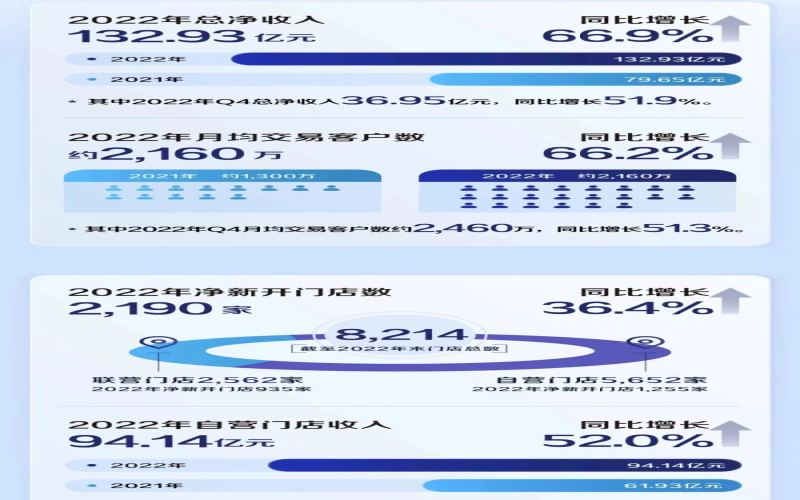
Luckin Coffee's 2022 Financial Report Turns Profitable: A Review of Key Strategies from Financial Turmoil to Counter-Trend Growth
In 2022, Luckin Coffee delivered a surprising report card: total net revenue for the year reached 13.293 billion yuan, and operating profit turned positive for the first time. From a record-breaking Nasdaq listing, to delisting due to financial fraud and a top-management reshuffle, and then to completing debt restructuring and returning to profitability, this brand's journey has been more twists and turns than a TV drama. Under the double squeeze of the pandemic's impact and debt pressure, what did Luckin rely on to turn things around? This article will sort through its pace of store expansion, coupon strategy, hit-product logic, launch speed and pricing, franchising and lower-tier market layout, as well as key moves such as signing endorsements and youth-oriented marketing, to reconstruct a more complete path of Luckin's recovery. [more…]
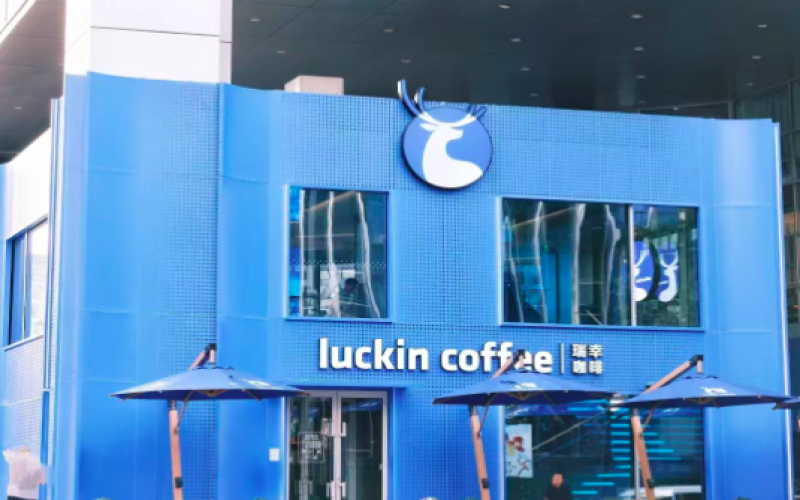
Luckin surpasses 20,000 stores but faces profit pressure: the coffee industry dilemma behind the price war and declining same-store sales
Luckin Coffee's Q2 2024 financial report shows total net revenue of 8.403 billion yuan and net profit of 871.1 million yuan, with the total number of stores approaching 20,000. However, same-store sales at self-operated stores fell 20.9% year-on-year, and Starbucks' same-store sales in the Chinese market also dropped 14%. Beneath the surface of growth in both revenue and store count, the same-store data reveals hidden concerns. The price war continues to escalate, with promotions of 9.9 yuan or even 6.6 yuan emerging one after another. Brands are trading low prices for sales volume, yet profitability pressure is hard to conceal. Leading brands and small and medium-sized brands alike are caught in the scramble for locations, with stores opening ever more densely while the survival space of individual stores is continuously squeezed. This article will combine the latest financial report data to analyze why Luckin finds it harder to make money amid scale expansion, and to explore the evolution of the competitive landscape in the coffee industry. [more…]
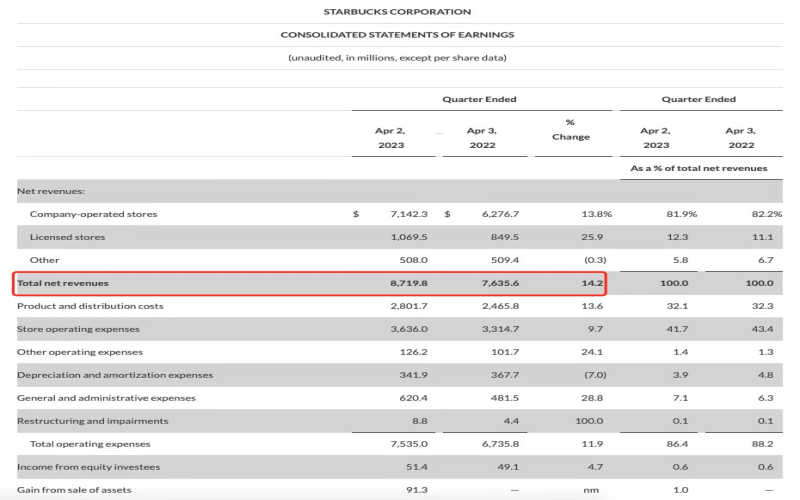
Starbucks reports dual growth in revenue and profit for Q2 of fiscal year 2023, with same-store sales in the Chinese market reaching a turning point.
Starbucks recently released its second-quarter results for fiscal year 2023, with both global consolidated revenue and net profit achieving year-over-year growth, while same-store sales in the Chinese market turned positive for the first time since the third quarter of fiscal year 2021. Against the backdrop of accelerating store expansion, optimistic remarks from the founder, and the rapid growth of competitor Luckin Coffee, whether Starbucks can ride this momentum to steadily advance its 2025 China market strategic vision is worth watching. [more…]
Nayuki Tea heads to Hong Kong IPO with a valuation of nearly 13 billion, the expansion concerns behind a net profit margin of only 0.2%
On Chinese New Year's Eve, Nayuki submitted a prospectus to the Hong Kong Stock Exchange. This premium freshly made tea beverage brand, centered on "fruit tea + soft European bread," has completed five rounds of financing and is now valued at nearly RMB 13 billion. However, behind the glossy listing process, its 2020 net profit margin was only 0.2%, with net profit of just RMB 4.484 million, raising concerns about the cost pressures and profitability shortcomings brought by rapid expansion. Can Nayuki leverage its listing to become a dark horse in the new-style tea beverage track? This article will sort through the valuation, membership system, store expansion, financial data, and industry views for you one by one. [more…]
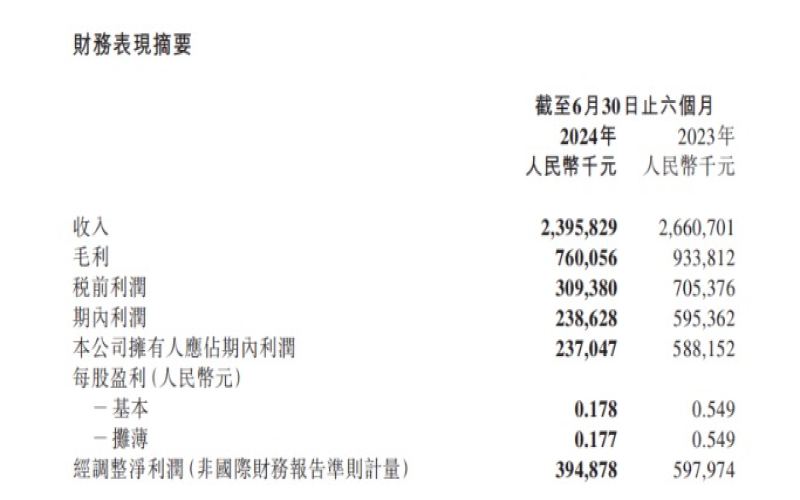
Tea Baidao's first semi-annual report after listing is out: net profit fell nearly 60% year-on-year, with franchise support and supply chain weaknesses in the spotlight.
The first half-year report delivered by ChaPanda after its listing in Hong Kong shows that both revenue and net profit declined in the first half of 2024, with net profit falling by nearly 60% year-on-year. The company attributes this to increased support for franchisees and greater market investment. At the same time, the number of stores continues to grow, but its market value has shrunk significantly, and its reliance on external suppliers for its supply chain is also seen as a key weakness. This article will sort through the core data in the financial report, the adjustments to franchise policy and their knock-on effects, and compare the competitive landscape of the industry, to help coffee and tea beverage enthusiasts understand the challenges this brand currently faces. [more…]

Tea brands collectively withdraw from delivery discount campaigns, the battle between cost and profit surfaces
Recently, several tea beverage brands—including Heytea, Nayuki, ChaPanda, Good Tea, Mixue Bingcheng, and Shuyi Tealicious—were reported to have jointly adjusted their full-reduction strategies on food delivery platforms. The original full-reduction discounts have been uniformly changed to 1 off 50, 1 off 70, or even canceled outright. Once the news broke, related topics quickly trended on social media, with views exceeding 180 million. Merchants say profits are thin, while netizens question why milk tea, which isn't cheap, still isn't making money. Behind this controversy lie both the pressure of platform commissions and delivery costs, and a reflection of the difficult position of the new tea beverage industry, caught between price cuts and losses. [more…]

How Coffee Shops Can Break Out of the Price War Trap: The Reality and Way Forward for Independent Cafés to Stay Profitable
When Luckin and Cotti's 9.9-yuan price war swept the market, a large number of coffee shops went bankrupt amid fierce competition. A Shanghai coffee shop owner recently shared his real situation: although delivery order volume grew, profits still could not cover costs, and he remained short of the break-even line. Can the low-price strategy be sustained? How can independent stores find room to survive in the cracks between chain brands? Starting from one shop owner's personal experience, combined with netizens' suggestions and industry realities, this article explores the key path to break-even operation for coffee shops—from pre-opening cost planning and store positioning to differentiated products and customer loyalty building—providing coffee practitioners with a practical business reference. [more…]
Ethiopia Red Cherry Project Wateema Washed Beans: A Complete Analysis of Flavor, Region, and Processing Method
Operation Cherrie Red is a quality improvement project initiated by the Dutch company Trabocca, aimed at incentivizing smallholder farmers in Ethiopia to produce high-quality coffee. This article focuses on the Wottuna Boltuma washed beans from Front Street Coffee's Ethiopian Operation Cherrie Red, providing a detailed introduction to the program's operating model, stringent selection criteria, regional characteristics, and cup flavor profile. From hand-picking fully ripe red cherries to requiring a cupping score of 88 or above for selection, Operation Cherrie Red returns all profits to participating farms. These washed beans originate from the Sidama region, are grown by 260 smallholder farmers at an elevation of 1,900 meters, and the volcanic clay soil nurtures jasmine and rose aromas, black tea and bergamot sweetness, and a clean mouthfeel, making them well worth exploring for coffee enthusiasts. [more…]

Vitasoy's half-year net profit plunges 95%, recovery in the mainland market expected to take three years after boycott wave
Vitasoy International Holdings' interim results for the 2021/2022 fiscal year show that revenue fell 18.28% year-on-year, while net profit plunged 95%, marking the largest decline in recent years. The core trigger of this storm was the public backlash caused by the July 2021 incident in which an employee attacked police and then hanged himself, leading to large-scale product removals and celebrity contract terminations in the mainland market—a key region accounting for 60% of the company's total revenue. The incident occurred during the summer sales peak, obstructing new product promotion, while competitors seized the opportunity to accelerate penetration. Industry analysts pointed out that in addition to the public relations crisis, Vitasoy's structural weaknesses in the mainland market—over-reliance on the Pearl River Delta and insufficient penetration in the north—were equally fatal. Rising raw material costs and slow packaging updates further dragged down recovery, and it is expected to take at least three years to restore profitability. This article will sort out the sequence of events, market reactions, and future challenges, providing in-depth reference for observers in the coffee and beverage industry. [more…]